Divorce by Mutual Agreement (DMA) is now the sixth fact for divorce in Singapore. Married couples who agree that their marriage has irretrievably broken down may now rely on mutual agreement as the reason for divorce.
This option allows couples to acknowledge that their marriage has irretrievably broken down without assigning blame to either spouse.
This amendment to the Women’s Charter enables couples to divorce without relying on the traditional facts of adultery, desertion, unreasonable behaviour, or periods of separation as the basis for the breakdown of the marriage.
– Joint Responsibility Under DMA
– Reasons for Divorce by Mutual Agreement
– Requirements for DMA
– Benefits of DMA
– How to Get Started
– How the DMA Process Works
– DMA & Judicial Separation
– ADR & Resolving Disputes
– Mandatory Co-Parenting Programme
– DMA & Co-Parenting
– Speak with Gloria James-Civetta & Co
– Frequently asked questions
Joint Responsibility in Divorce by Mutual Agreement (DMA)
Under DMA, both spouses acknowledge that the marriage has irretrievably broken down without attributing fault to one another.
Where the divorce itself is not contested, parties may rely on DMA under both the Simplified Track and the Normal Track.
What Reasons Can Be Relied Upon for Divorce by Mutual Agreement?
Examples of reasons that parties may rely upon include:
- Vast differences in values, culture or religion;
- Being unable to see eye-to-eye;
- Constant misunderstandings;
- No longer having any love or intimacy for each other; and
- Growing apart and no longer seeing a future together.
What are the Requirements of Divorce by Mutual Agreement (DMA)?
To rely on DMA as a fact for divorce, the following requirements must be fulfilled:
- Parties must be married for at least three years. The general restriction on filing for divorce during the first three years of marriage continues to apply.
- Parties must have a written agreement confirming that the marriage has irretrievably broken down. The agreement must include:
- the reasons that led the parties to conclude that the marriage has irretrievably broken down;
- the efforts the parties have made to reconcile; and
- the consideration given to arrangements concerning their financial affairs and any children of the marriage.
Benefits of Divorce by Mutual Agreement
DMA offers a number of practical and emotional benefits for couples who are able to work together towards an uncontested divorce.
The benefits include:
- Avoids assigning blame, allowing the marriage to end with greater dignity and respect.
- Encourages cooperation, making discussions about children, finances and future arrangements more constructive.
- Helps preserve a working relationship, particularly important where parents will continue to co-parent after the divorce.
- Reduces unnecessary conflict, which may lessen the emotional impact on both the parties and their children.
- Supports negotiated outcomes, allowing couples to focus on finding practical solutions rather than arguing over fault.
- Provides greater certainty, as parties who reach agreement are generally better able to understand and plan for their post-divorce arrangements.
How Does Divorce by Mutual Agreement Usually Begin?
For many couples, Divorce by Mutual Agreement begins with an open discussion about the breakdown of their marriage.
Rather than assigning blame, both parties consider whether they accept that the marriage has irretrievably broken down and whether they can work together towards an uncontested divorce.
These discussions often include:
- the division of matrimonial assets;
- child and spousal maintenance;
- arrangements for the children, including custody, care and control and access; and
- how they would like the divorce process to proceed.
Not every issue has to be resolved immediately. However, identifying the areas of agreement early often helps the process move forward more smoothly.
For Divorce by Mutual Agreement, both parties must agree that the marriage has irretrievably broken down. The Court also requires the parties to explain the reasons that led to that conclusion, the efforts they have made to reconcile, and the consideration they have given to arrangements concerning their financial affairs and any children of the marriage.
How Does the Divorce by Mutual Agreement (DMA) Process Work
Once the parties have reached agreement on some or all of the issues, the next step is to engage a family lawyer to prepare the divorce documents.
A lawyer’s role extends beyond simply preparing forms. Your lawyer will ensure that the agreed terms are properly recorded, identify matters that should be considered before filing, explain any issues that may affect the application and prepare the documents in a form that complies with the Court’s requirements.
Careful preparation at this stage often helps the application proceed smoothly and reduces the likelihood of unnecessary delays or future applications.
The parties will also be required to affirm the documents before a Commissioner for Oaths.
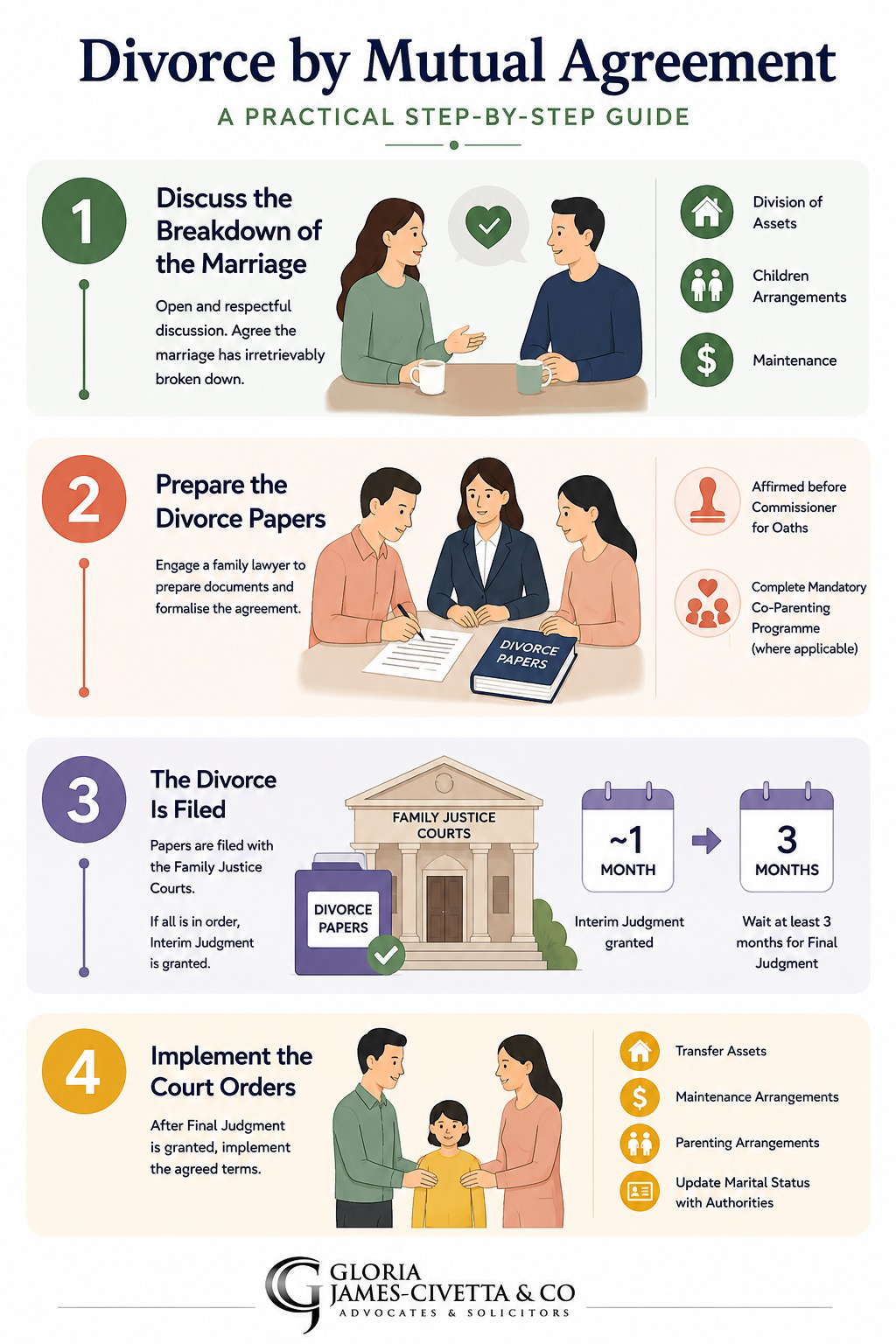
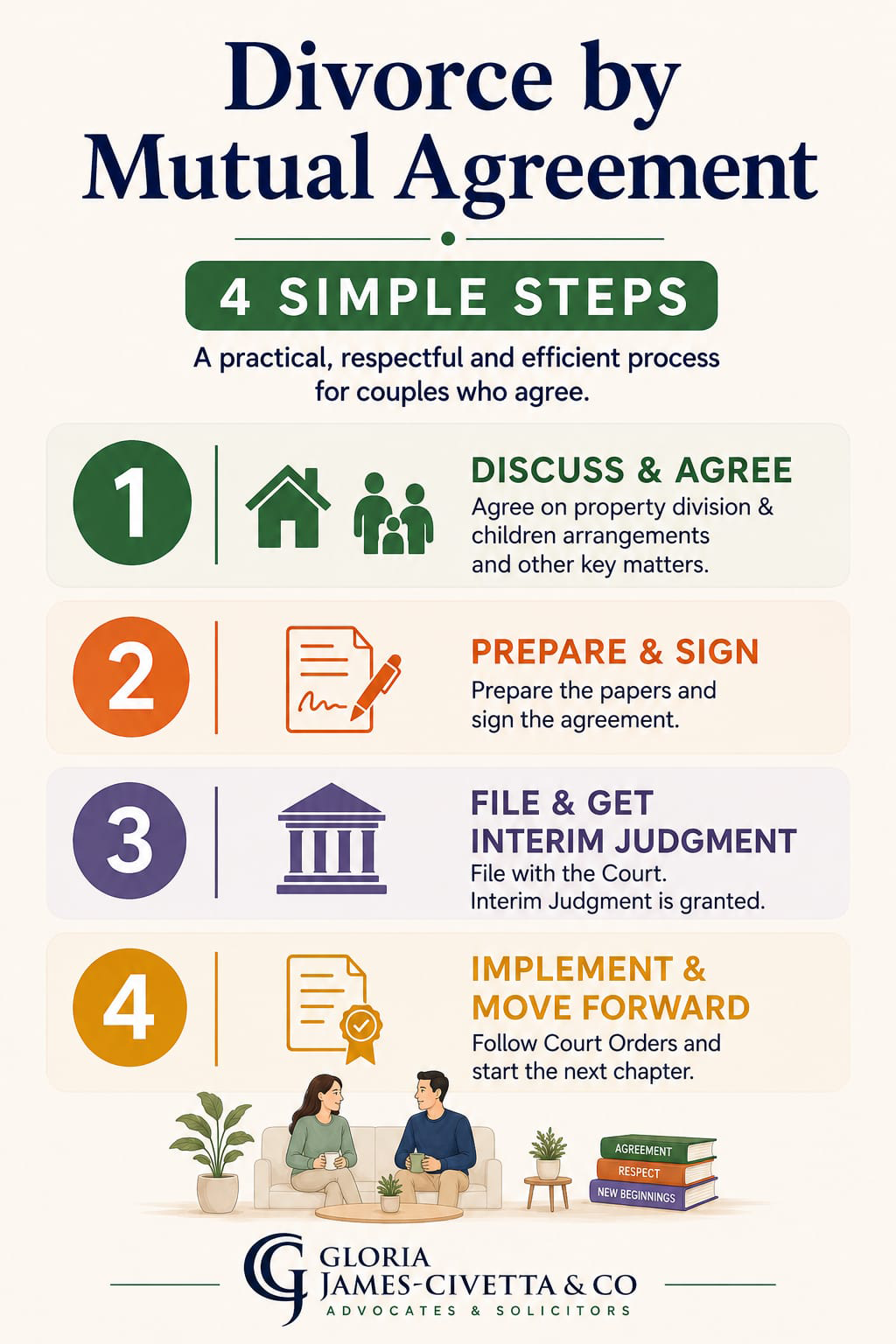
Step 1 – Discuss the Breakdown of the Marriage
Both parties begin by discussing the breakdown of their marriage without assigning blame.
The discussion then turns to whether they can reach agreement on matters such as:
- Division of matrimonial assets;
- Child and spousal maintenance; and
- Arrangements for the children, including custody, care and control and access.
For DMA, both parties must agree that the marriage has irretrievably broken down and explain the efforts they have made to reconcile before deciding that divorce is the appropriate way forward.
Step 2 – Prepare the Divorce Papers
Once the parties have reached agreement, or substantial agreement, they should engage a family lawyer to prepare the divorce documents.
The lawyer will ensure the agreed terms are properly documented, comply with the Court’s requirements and assist with the formalisation of the divorce papers.
The parties will affirm the documents before a Commissioner for Oaths and, where applicable, complete the Mandatory Co-Parenting Programme before the divorce application is filed.
Step 3 – The Divorce Is Filed
Once the divorce papers have been filed, the Family Justice Courts will fix an administrative hearing date.
For most uncontested DMA applications, neither the parties nor their lawyers are required to attend Court.
If everything is in order, the Court will grant an Interim Judgment. Generally, the Final Judgment may be extracted three months later, provided all outstanding matters have been resolved.
Step 4 – Implement the Court Orders
The Court will generally grant the Interim Judgment about one month after the divorce application is filed. The parties must then wait at least three months before applying for the Final Judgment.
Once the Final Judgment has been granted, the parties proceed with implementing the agreed terms contained in the Court Order.
This may include transferring assets, implementing maintenance arrangements, carrying out the agreed parenting arrangements and updating their marital status with the relevant authorities.
Divorce by Mutual Agreement (DMA) and Judicial Separation
If couples married for less than three years are unable to annul their marriage and prefer not to pursue a fault-based separation, they may rely on the new sixth fact of Divorce by Mutual Agreement when applying for judicial separation.
This option enables couples to address the breakdown of their relationship without assigning blame while resolving issues concerning their financial affairs and children, rather than waiting until they become eligible to file for divorce.
The Court will only accept the agreement if it is satisfied that the requirements have been met or if it considers there remains no reasonable prospect of reconciliation.
Using Alternative Dispute Resolution (ADR) Approaches for DMA
As parties are encouraged to resolve issues concerning the division of matrimonial assets, maintenance and child arrangements, Alternative Dispute Resolution (ADR) approaches such as pre-writ negotiations, collaborative family practice and mediation are strongly encouraged.
These processes often assist couples in reaching practical and workable agreements before Court proceedings become necessary.
Once agreement has been reached, the agreed terms may be recorded in a formal written agreement.
Mandatory Co-Parenting Programme
Couples with minor children who are required to complete the Mandatory Co-Parenting Programme must do so before filing for divorce.
The programme is intended to help parents better understand the impact of divorce on their children and encourage cooperative parenting after separation.
Divorce by Mutual Agreement (DMA) and Co-Parenting
DMA provides an opportunity for couples to move through the divorce process with less conflict. This is particularly important where children are involved, as parents will often need to continue communicating and making decisions together long after the divorce has been finalised.
Speak with Gloria James-Civetta & her Family Law Team
If you and your spouse believe your marriage has irretrievably broken down and are considering Divorce by Mutual Agreement, obtaining legal guidance early can help you better understand the process and avoid unnecessary delays.
Ms Gloria James-Civetta and her Family Law team regularly assist couples in preparing Divorce by Mutual Agreement applications, formalising agreed terms and ensuring the necessary Court documents comply with the Family Justice Courts‘ requirements.
Whether you have already reached agreement or are still working through issues relating to your children, maintenance or the division of matrimonial assets, we can guide you through the process and help you move forward with clarity and confidence.
We offer a complimentary 20-minute Divorce by Mutual Agreement Process Call to help you understand how the process works, what to expect, the likely costs and the next steps involved.
If you require legal advice specific to your circumstances, including your rights, entitlements or a proposed settlement, we also offer a Strategic Divorce Consultation with one of our experienced family lawyers.
Frequently Asked Questions About Divorce by Mutual Agreement (DMA)
Divorce by Mutual Agreement (DMA) allows spouses to divorce without assigning blame to either party. Instead, both spouses jointly acknowledge that the marriage has irretrievably broken down and explain the reasons for that conclusion, the efforts made to reconcile, and the arrangements they have considered for their finances and any children of the marriage.
Not necessarily.
Both parties must agree that the marriage has irretrievably broken down. While it is preferable to reach agreement on matters such as children, maintenance and the division of matrimonial assets before filing, a family lawyer can assist parties in resolving outstanding issues and preparing the necessary Court documents.
Yes.
Although both parties agree that the marriage has irretrievably broken down, disagreements may still arise over ancillary matters such as child arrangements, maintenance or the division of matrimonial assets.
Where these issues cannot be resolved, the Court may determine them even though the divorce itself proceeds by mutual agreement.
Many couples choose to engage a lawyer even where they have reached agreement.
A family lawyer can ensure the agreed terms are properly documented, comply with the Court’s requirements and assist in preparing and filing the divorce papers. Proper preparation may also help avoid unnecessary delays or future disputes.
The timeframe varies depending on the circumstances of each case.
Where the application proceeds smoothly, the Court may grant an Interim Judgment, with the Final Judgment generally available at least three months later, provided all outstanding matters have been resolved.
Parents must consider arrangements relating to:
- Custody;
- Care and control;
- Access; and
- Child maintenance.
Where applicable, parties must also complete the Mandatory Co-Parenting Programme before filing the divorce application.
The welfare of the child remains the Court’s paramount consideration.
There is no prescribed list.
Common examples include:
- growing apart;
- fundamental differences in values;
- ongoing misunderstandings;
- loss of emotional connection; or
- recognising that reconciliation is no longer possible despite attempts to repair the relationship.
The reasons should genuinely explain why both parties have concluded that the marriage has irretrievably broken down.
Generally, no.
The usual three-year restriction on filing for divorce still applies.
However, depending on the circumstances, some couples may wish to explore other legal options, such as judicial separation or an annulment where the legal requirements are met.
For many uncontested Divorce by Mutual Agreement applications, neither the parties nor their lawyers are required to attend Court.
The Family Justice Courts will fix an administrative hearing date, and if all legal requirements have been satisfied, the Court may grant the Interim Judgment without a Court attendance.
The first step is usually to discuss whether both parties agree that the marriage has irretrievably broken down and whether they can reach agreement on issues such as:
- children;
- maintenance;
- matrimonial assets; and
- the overall divorce process.
Once there is agreement, or substantial agreement, a family lawyer can assist in preparing the necessary Court documents and guide the parties through the remaining steps of the process.

We’re here for you
We aim to ensure that your divorce case goes smoothly and as efficiently as possible.
Reach out to us if you require more information about the new legislation regarding divorce by mutual agreement.