
“Annulment is a legal procedure for declaring a marriage null and void. An annulled marriage is considered to be invalid from the beginning, almost as if it had never taken place”
- An annulment is different from a divorce and is only available where the marriage is void or voidable under Singapore law.
- A void marriage is treated as invalid from the outset, while a voidable marriage remains valid unless and until it is annulled by the Court.
- Grounds for annulment may include non-consummation, lack of valid consent, certain existing marriages and other circumstances recognised by law.
- The usual three-year restriction on filing for divorce does not apply in the same way to an annulment, but specific legal grounds must still be established.
- Some grounds for annulment are subject to time limits and other restrictions, making it important to understand which ground may apply.
- If the requirements for annulment are not satisfied, divorce may be the appropriate alternative, subject to the requirements for filing.
What is an Annulment? How is it different from a divorce?
An annulment is a legal procedure to dissolve a marriage, declaring it null and void. However, unlike divorce proceedings, an annulment works on the basis that the marriage never properly existed in the first place.
It is possible to consider a nullified marriage as an alternative to divorce. However, one must bear in mind the qualifying grounds for an annulment of marriage, which can be rather different than the typical grounds for divorce.
Does my marriage qualify for an annulment?
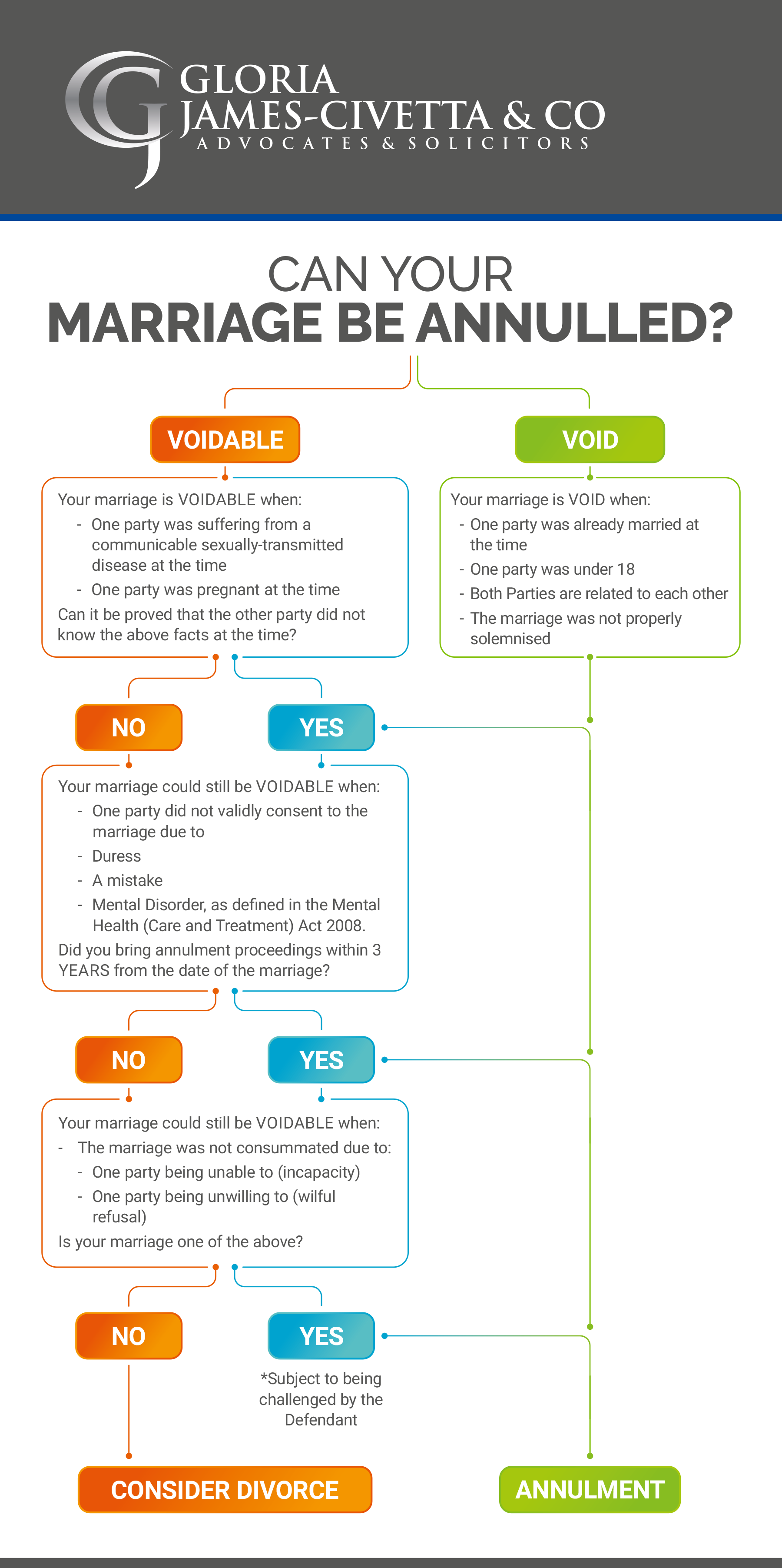
Chapter 3 of the Women’s Charter separates annullable marriages into ‘void’ and ‘voidable’ marriages. While void marriages are automatically annulled, voidable marriages can still be challenged. This applies to all marriages that have taken place after 1st June 1981.
The following marriages are void under s. 105 of the Women’s Charter:
- s. 3(4), A marriage between persons who are Muslims
- s. 5(1), Anyone who is already lawfully married to a spouse under any law, religion, custom or usage.
- s. 9, A marriage between persons below the age of 18 years, unless specially authorized the Minister (under s. 21 of the Women’s Charter).
- s. 10, A marriage within specific degrees of kindred and affinity (as defined in the First Schedule of the Women’s Charter).
- s. 11, A marriage in which either party is already married under any law, religion, custom or usage to another person.
- s. 22, A marriage that has not been solemnized in the presence of 2 or more witnesses
- on the authority of a valid marriage license,
- by the Registrar or someone who has been granted a license to solemnize the marriage.
The following marriages are voidable under s. 106 of the Women’s Charter:
- s. 106(a), s. 106(b), Unconsummated marriages, due to one party being either unable or unwilling to consummate it
- s. 106(c), A marriage that has not been validly consented to, due to one party consenting under duress, by mistake, or with a mental disorder, etc.
- s. 106(d), A marriage that was validly consented to but, at the time of marriage, one party was suffering from a mental disorder that left them unfit for marriage (as defined in the Mental Health (Care and Treatment) Act 2008)
- s. 106(e), A marriage where, at the time of marriage, the Defendant was suffering from a communicable sexually-transmitted disease
- s. 106(f), A marriage where, at the time of marriage, the Defendant was pregnant by someone other than the Plaintiff.
How Do Annulment Proceedings Work?
An annulment application is made to the Family Justice Courts. Under section 104 of the Women’s Charter, either spouse may file an originating application for nullity of the marriage.
The person seeking the annulment will need to establish that the marriage is void or voidable on one of the grounds recognised under Singapore law. The evidence required will depend on the particular ground relied upon.
For a voidable marriage, there are also circumstances in which the Court may not grant an annulment. For example, certain grounds require proceedings to be started within three years of the marriage. In some cases, the applicant must also have been unaware of the relevant facts at the time of the marriage.
The Court may also refuse to annul a voidable marriage where the applicant knew that the marriage could be avoided but behaved in a way that reasonably led the other spouse to believe that an annulment would not be sought, and it would be unjust to the other spouse to grant it.
If the Court is satisfied that the legal requirements have been established, it may grant a judgment of nullity.
Because the applicable requirements depend on whether the marriage is void or voidable and the particular ground relied upon, it is important to identify the appropriate legal basis before commencing an annulment application.
Read more: Step-By-Step Guide to Annulment of Marriage in Singapore
What happens after the Annulment?
If a Plaintiff is successful in proving that the marriage is annullable, the court will grant a Judgement of Nullity, dissolving the marriage.
However, any children born in the marriage will still be considered legitimate children.
Annulments can be confusing and intimidating. However, with a clear understanding of what to do, and the advice of a lawyer, an annulment may provide you with a viable alternative to divorce.
Read more: What Happens to your HDB Flat after Annulment of Marriage
Read more: What’s the Legal Difference Between Annulment and Divorce
When should I speak to an annulment lawyer?
You should consider speaking to an annulment lawyer if you believe your marriage may be void or voidable, particularly where there are issues involving non-consummation, lack of valid consent, duress, an existing marriage or other circumstances that may affect the validity of the marriage. Some grounds are also subject to time limits, so obtaining advice early can help you understand whether annulment is available in your circumstances.

We’re here for you
At Gloria James-Civetta & Co, we aim to find a solution that will work for you and your family. Our matrimonial law team will provide a consultation tailored to your circumstances and needs.