Receiving divorce papers can be unsettling, particularly where the documents arrive unexpectedly or are handed to you by your spouse or your spouse’s lawyers.
However, before assuming that divorce proceedings have formally commenced against you, the first question to ask is: have you actually been served with Court papers, or have you simply received a lawyer’s letter or draft documents?
This distinction is important because formal Court documents may trigger specific deadlines for you to respond, and missing those deadlines may affect your ability to put your position before the Court.
If you are unsure what you have received, it is sensible to seek legal advice early. A divorce lawyer can help you identify whether the documents are official Court papers, explain what they mean, advise you on any deadlines that apply, and guide you on whether you need to respond immediately.
Legal advice can also help you understand whether you agree with the divorce itself, whether you disagree with any allegations made against you, and whether you need to contest issues relating to the children, maintenance or matrimonial assets.
How Do I Know Whether These Are Actual Court Papers?
If you have received documents relating to a divorce, the first thing to check is whether they are actual Court documents or merely draft documents or correspondence from the other party’s lawyers.
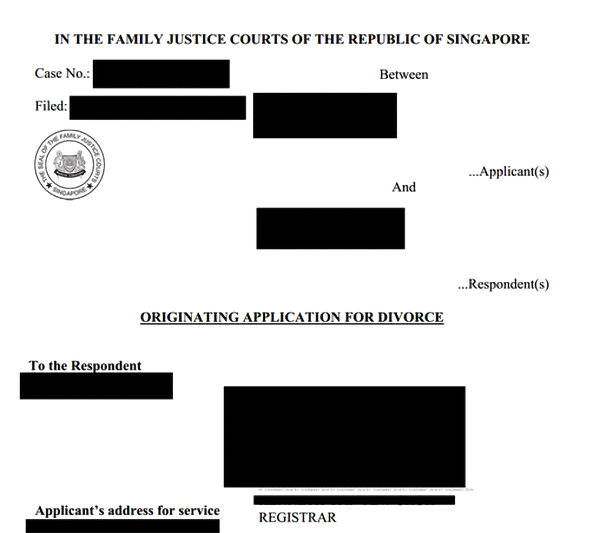
Official Court documents can generally be identified by several features. They will typically contain:
- the Court Seal bearing Singapore’s Coat of Arms;
- a Court case number;
- the date on which the document was filed or issued; and
- the signature or authentication of the Registrar.
The Court Seal is one of the clearest indicators that the document has been formally issued by the Singapore Courts.
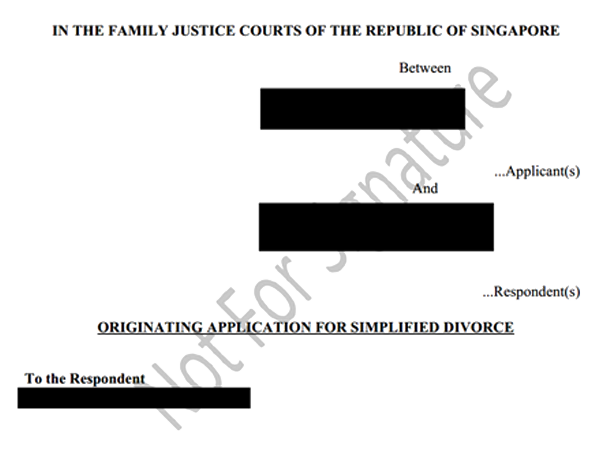
By contrast, if the document is marked “NOT FOR SIGNATURE”, appears to be a draft, or is simply a letter from the other party’s lawyer, this does not, by itself, mean that you have been formally served with Court papers.
A lawyer’s letter will typically be on the law firm’s letterhead and will not contain the Court Seal because it has not been issued by the Court. If you are unsure, do not assume that the documents are formal Court papers merely because they look legal or have been sent by a lawyer. Check whether they bear the Court Seal, case number, filing or issuance date and Registrar’s authentication, and seek legal advice if you remain uncertain.
Do Not Feel Pressured to Sign Anything Immediately
Whether you have received actual Court papers or proposed documents from the other party’s lawyers, do not feel pressured to sign anything simply because the other party or their lawyer asks you to do so.
You should first understand what the document says and the consequences of signing it.
For example, you may be asked to sign documents stating that you agree to the divorce, or documents containing proposed arrangements relating to the children, maintenance or matrimonial assets. Signing a document without understanding its effect may prejudice your position later.
The other party’s lawyer acts for the other party. They do not act for you and are not responsible for advising you whether the terms proposed are in your interests.
If you are unsure, obtain independent legal advice before signing.
If They Are Court Papers, Check Your Deadlines Immediately
Receiving divorce papers does not mean that the divorce has already been granted. You still have an opportunity to respond and state your position.
However, Court papers should not be ignored because response deadlines may begin running from the date of service.
For divorce proceedings commenced on or after 15 October 2024 under the normal-track procedure, the documents and general deadlines referred to in the current procedure include:
| Document | General Deadline |
|---|---|
| Notice to Contest | Within 14 days of service |
| Reply, where applicable | Within 28 days of service |
| Cross-Application, where applicable | Within 28 days of service |
Different considerations may apply where documents are served outside Singapore or where the Court has given specific directions. It is therefore important to check the particular documents served on you rather than assuming that every case follows exactly the same timetable.
Read more: Simplified vs Normal Track Divorce
Decide What You Actually Disagree With
After understanding the documents, you will need to decide what position you wish to take.
There is an important distinction between agreeing that the marriage should end and agreeing to everything your spouse is asking for.
You may agree that the marriage has irretrievably broken down while disagreeing with your spouse’s proposals regarding the children, maintenance, the matrimonial home or division of matrimonial assets.
Similarly, you may disagree with the reasons or allegations relied upon by your spouse for the divorce itself.
Your response will therefore depend on whether you intend to contest the divorce, the ancillary matters, or both.
Frequently Asked Questions
If you agree that the marriage has irretrievably broken down, the dissolution of the marriage may proceed on an uncontested basis.
However, this does not necessarily mean that you must agree to the particulars stated, all of the financial or children-related arrangements proposed by your spouse. You should ensure that any agreement concerning custody, care and control, access, maintenance and matrimonial assets properly reflect your position before agreeing to the terms.
If you disagree that the marriage has irretrievably broken down, dispute the facts relied upon by your spouse, or disagree with the ancillary relief sought, you may need to contest the relevant parts of the proceedings.
The Court may thereafter give directions, arrange case conferences or mediation, or ultimately fix the disputed issues for hearing if they cannot be resolved. Contested proceedings may also take longer and involve higher legal costs.
You should not ignore divorce papers.
If you do not file the necessary documents within the applicable deadlines, the proceedings may continue without your participation. The Court may proceed with the dissolution of the marriage and may make orders concerning the children, property or maintenance which will still be binding on you.
Failing to respond does not necessarily mean that every order sought by your spouse will automatically be granted. However, you may lose the opportunity to properly put your position before the Court at the appropriate stage.
If the deadline has already passed, do not assume that there is nothing you can do.
Depending on the stage of the proceedings and the circumstances of the delay, it may be possible to seek an extension of time or other directions from the Court. An extension is not automatic, and additional costs or costs orders may arise.
You should therefore obtain advice as soon as possible rather than allowing further time to pass.
Read more: How to Serve Divorce Papers in Singapore
Speak to a Divorce Lawyer Before Responding or Signing
If you have received documents from your spouse or their lawyers, the safest first step is to establish exactly what documents you have received, whether they have been filed in Court, whether any deadlines are running, and what the documents require you to do.
A divorce lawyer can review the papers, explain the allegations and orders being sought, advise you on the applicable deadlines and help you decide whether you should agree, negotiate or contest the proceedings.
Most importantly, receiving documents from the other party’s lawyer does not mean that you must immediately agree to or sign what has been put before you.
Understand what you are being asked to agree to first, obtain independent advice where necessary, and make an informed decision about your next steps.
Seek Advice from Our Divorce Lawyers
If you have been served with divorce papers, seeking legal advice early can help you understand your position, the options available and the steps you need to take.
At Gloria James-Civetta & Co, our team of divorce lawyers can assist you with the following:
- Explaining the contents of the divorce papers;
- Understanding your legal rights and obligations;
- Guiding you through the Singapore Divorce Process;
- Explaining the laws applicable at different stages of the proceedings;
- Addressing questions or concerns about your circumstances.

We’re here for you
Should you require legal representation, kindly contact Gloria James-Civetta & Co for a free consultation with one of our divorce lawyers.

Legal Advice or Divorce Coaching: Where Do You Start?
The Lantern in the Quiet Room

15-Month HDB Wait-Out Period Removed: What the Change Means for Divorcing Couples in Singapore

Considering Divorce? When to Seek Legal Advice and What to Know Before You Decide

What Happens to CPF Monies and Property Sale Proceeds After a Divorce Order?